Methodology and Sources
Items were sourced where possible from government sources, notably Ontario’s Auditor General and Financial Accountability Officer, Ontario’s Public Accounts, Provincial Budgets and statements by the Premier and Ministers, as well as City of Toronto staff reports. We also rely on the careful work of journalists at the CBC, Toronto Star, Globe and Mail, Canadian Press, Narwhal and Trillium, often based on Freedom of Information requests, and in the case of health care spending, the Canadian Centre for Policy Alternatives. Where conflicting cost estimates existed, we used the more conservative estimate. This list is not exhaustive; it represents currently well-documented cases.
Corporate Welfare and Insider Deals
407 Fee Bailout: Source: Freedom of Information request by Paul Webster at the Toronto Star. Represents fees that could have been, but were not, recouped by the province from the 407 during the pandemic.
Skills Development Fund project Ministry staff ranked as poor, low and medium quality: Source: Ontario’s Auditor General’s report on SDF program. The report found higher ranked projects were left unfunded
Metrolinx executive severance package: Represents estimated minimum severance due to Ontario’s highest-paid public servant, Phil Verster, whilst Metrolinx delivered major projects late and over budget. Ontario sunshine list (salary) reviewed by Colin d’Mello and Isaac Callan, Global news; Employment Standards Act (severance estimate)
Environment & Revenue Policy: Estimate is conservative
Includes several cases in which new, functioning infrastructure was removed, despite 1) polling evidence indicating the removal was unpopular and 2) government staff or outside experts recommending against the move.
Carbon pricing court loss: Ford’s legal budget for court case described by CBC’s Mike Crawley
Bike Lane Removals: Toronto City staff report, reported by CBC’s Muriel Draaisma
Speed Camera Replacement: Provincial announcement of funds available to replace removed infrastructure, reported by Canadian Press’ Allison Jones
Includes cuts to revenues benefiting individual taxpayers less than $360 per year (one week’s worth of groceries for the average family of four, 2025) but with major impacts (above $100,000,000 a year) on the Provincial budget, representing the
Permanent gas and fuel tax reduction (annual, recurring): Ontario 2025 Provincial Budget, p. 249. Value of lost revenue increases in subsequent years
Cap-and-trade cancellation (4 years): Estimation of the impact of the cancellation on Ontario’s budget over four years by Ontario’s Financial Accountability Officer
Cancellation of renewable energy projects: Ontario’s Public Accounts, reviewed by Canadian Press
Note: Bike lane removal and speed camera replacement costs represent possible future liabilities
Legal Fights & Court Losses: Estimate is conservative
Greenbelt-related legal costs: Full legal costs have not been disclosed. These amounts represent claims by affected municipalities (reported by Global News’ Isaac Callan and Colin D’Mello) and continued salary payouts to staff terminated in connection with the scandal (reported by the Trilllium and The Narwal)
Bill 124 legal costs: Response by Ontario’s Ministry of the Attorney General to queries by the Canadian Press. Money represents the cost of unsuccessfully pursuing a wage cap for 800,000 workers, later found unconstitutional.
Ontario Place & Mega-Projects: Non-exhaustive examples
401 Tunnel Feasibility Study: Ministry of Transportation spokesperson, cited by Global News’ Isaac Callan and Colin D’Mello
Ontario Science Centre replacement: Represents the most conservative estimate of the additional cost of replacing the Science Centre at Ontario Place (Auditor General report) over the cost of a full repair of the existing facility (Infrastructure Ontario business case reviewed by Auditor General). Canadian Architect’s review of the repair case argues the estimated costs of repair are inflated.
Ontario Place site improvements (Infrastructure Ontario documents obtained by Globe and Mail’s Jeff Gray) and parking garage estimate (Auditor General report); represents the most conservative estimate of the cost publicly funded work benefiting the privately operated Therme spa.
Note: some of the funds associated with the Ontario Science Centre and Ontario Place project represent potential future liabilities
Politically Advantageous Spending - non-exhaustive examples
Ads for controversial government initiatives: Represents just two of many examples: The “Ronald Reagan” ad campaign in the US credited with derailing tariff negotiations, and the Ring of Fire advertisements under fire for misleadingly using images from other countries to represent projects in Ontario’s north.
Record government advertising: Spending in the two years ahead of the 2025 snap election promoting the incumbent administration and not also delivering goods or services to Ontario residents.
Pre-election rebate cheques. $200 payments sent directly to all Ontario residents ahead of the 2025 snap election.
Botching privatization rollout - example
A report by Ontario’s Financial Accountability Officer found that Ontario’s LCBO retail privatization was already a net cost to taxpayers, but further missteps increased costs:
Initial cost of privatization
Beer store early contract termination fee (6 months early)
Acceleration of convenience/grocery store rollout (18 months early)
Privatized Health Costs - Conservative estimate
We rely on meticulous research undertaken by the Canadian Centre for Policy Alternatives (CCPA), which documents how a growing reliance on for profit providers has contributed to rising health care costs. Because over-charging varies by procedure and institution, it is difficult to capture in one number how much more expensive these services are each year compared to public services; better public reporting by the Ontario government is needed to properly assess cost burden. We consider these figures a conservative estimate, however, because they represent only a small sample of the eight years of the current administration, with little data yet after the government opened up the market to for-profit clinics beginning in 2023.
Private staffing agencies in public hospitals - Public spending on private staffing agencies in public hospitals one year (2022-2023), identified through Freedom of Information requests filed by the CCPA. The report estimates that private staffing agencies are at least three times as expensive as publicly employed staff.
Private Surgeries - the value of private surgeries at for-profit hospitals and for-profit Independent Health Facilities between 2018 and 2022, from a CCPA report based on Freedom of Information requests. In Ontario, private, for profit health care organizations are able to charge OHIP more than public hospitals for the very same procedures. Investigative reporting by the CBC’s Mike Crawley suggests in the case of cataracts, for-profit institutions charge OHIP about 2.5x more per procedure.
Transit Infrastructure Overruns
These estimates only include major transit projects announced at the beginning of Ford’s mandate (excluding, for example, the Eglinton Crosstown - even though construction costs for this project also increased between 2019 and 2026):
Yonge subway extension
Scarborough subway cost overruns
Ontario Line cost overruns
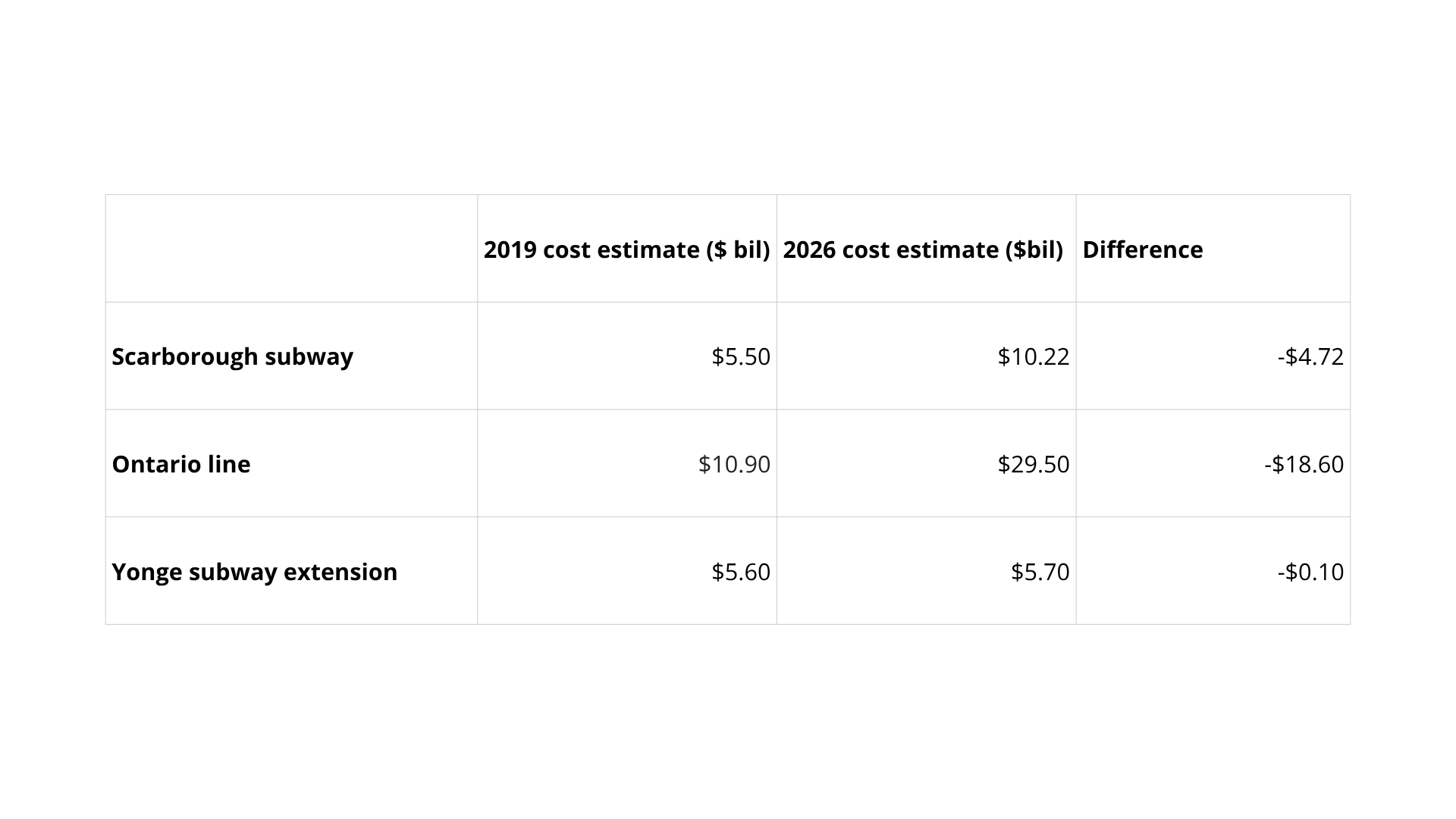
Initial costs for all three projects were announced in the 2019 Provincial Budget. Transit analyst Steve Munroe has compiled annual Capital Project Cost Tracking reports produced by Metrolinx for these and other projects, which represents the best available method to track changing total project construction costs.

This project and website development was supported by Terra Etc.